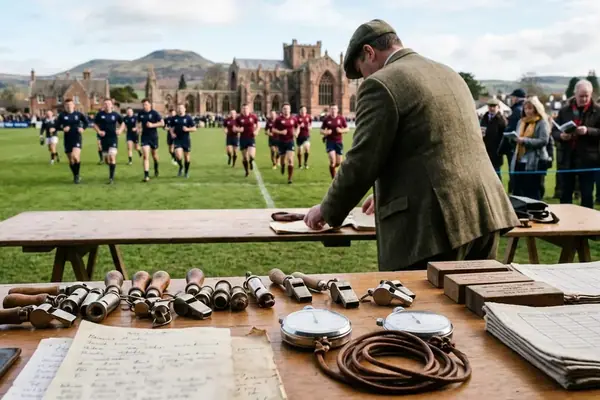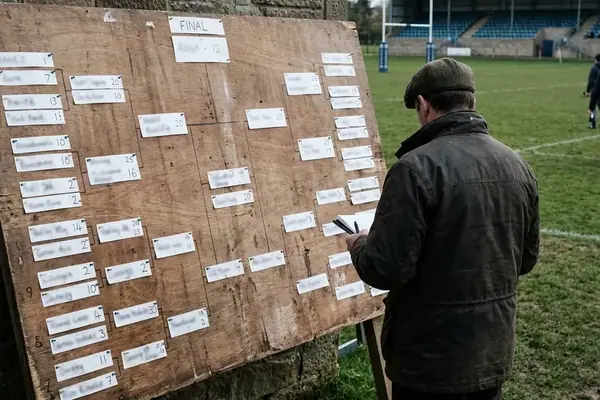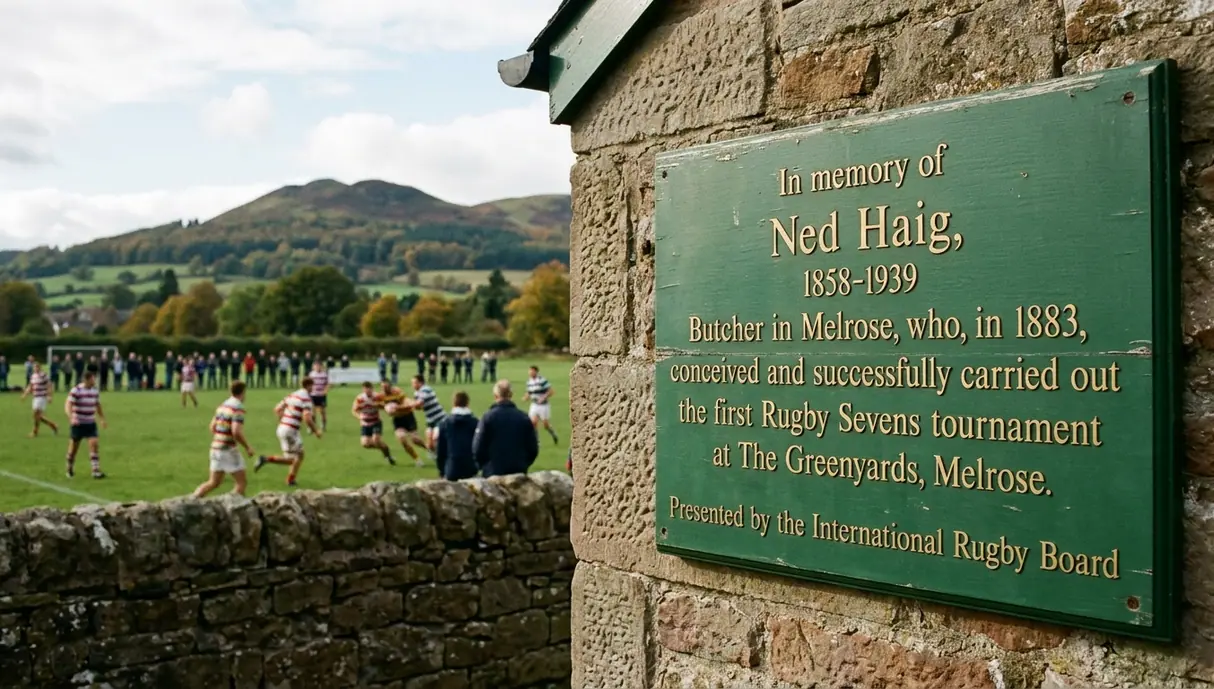
Rugby sevens did not begin as a polished international product. It began as a practical answer to a Borders problem: how could a small club stage enough rugby in one afternoon to raise money, entertain a crowd, and still leave the players standing?
That answer, shaped at Melrose in 1883, carried farther than its makers could have reasonably expected. The format kept the muscle of rugby, stripped away the waiting, and made every mistake visible. Its origin story matters because it explains why the game still feels urgent, local, and ceremonial, even when played on a global stage.
The 19th-Century Rugby Landscape and a Local Challenge
Why the Borders needed a different match format
In the early 1880s, rugby in the Scottish Borders was already more than recreation. Clubs carried local pride, social obligation, and the competitive habits of close-knit towns. A fixture was not simply a game; it was a public occasion, with committees, spectators, hospitality, and the awkward arithmetic of daylight.
The practical issue was blunt. Full-sided rugby matches took too long to stack into a single afternoon. A club wanting a sports day with several visiting teams could not easily run match after match without exhausting the programme, the pitch, or the patience of the crowd.
That constraint shaped the invention. Sevens was not created by abstract rule theorists looking for speed. It came from a committee-room problem: reduce the number of players, compress the match, and make a tournament possible.
The older sporting imagination of the Borders
The Borders also had a culture ready for physical, improvised, communal games. Fastern's E'en Ba, with its rough local energy and town-wide participation, belonged to the same sporting landscape that made people comfortable with contests that were noisy, tactical, and intensely place-bound.
Field Note: When reading the birth of sevens, start with logistics rather than mythology. The romance is real, but the mechanism was a scheduling solution.
That is why the Melrose story still holds. It combines local necessity with a regional appetite for public sport. The format worked because it answered both.
Ned Haig and the Inaugural 1883 Melrose Sports
The butcher, player, and committee proposal
Ned Haig, born in 1858 and later remembered as the central figure in the creation of rugby sevens, was both a Melrose butcher and a rugby player. That combination matters. He understood the town as a tradesman and the game as a participant, not as an outsider designing a spectacle from a distance.
Haig identified the obstacle facing the Melrose committee: full-sided matches could not fit a multi-game tournament into one afternoon. His proposal was clear and functional. Cut each side to seven players, shorten the contest, and let several teams compete in a single sports programme.
There is a useful lesson in that pitch. Good formats often emerge when the organizer respects the limits of the day. Haig did not dilute rugby; he concentrated it.
April 28, 1883
The first Melrose Sports and Sevens tournament took place on April 28, 1883. The date deserves its firm place in rugby history because it marks the point at which a local fundraising concept became a playable code variation.
On that afternoon, the new format had to prove itself in public. It needed to move quickly enough for the programme, remain recognizable as rugby, and produce a final worthy of the crowd's attention. Melrose defeated St. Cuthbert's in the first final, giving the host club both the experiment and the inaugural victory.
- Problem: too many full-sided matches for one afternoon.
- Proposal: seven players per side to enable a compact tournament.
- Outcome: the first Melrose Sevens tournament on April 28, 1883.
Bottom Line: Haig's importance lies not only in inventing a format, but in matching a rule change to a real event-management problem.
Original Rules, Formations, and the First Champions
How the opening sides were arranged
A beginner often assumes early sevens looked like modern sevens with heavier boots. It did not. The original 1883 formation placed one full back behind two quarter-backs, with four forwards ahead of them. That structure tells us what the first players valued: cover, handling, support, and enough forward presence to keep the game recognisably rugby.
The quarter-back role carried particular weight. D. Sanderson stood out in that position during the first tournament, and his prominence helps explain why the early game was not merely a sprint contest. Decision-making mattered. Space opened quickly, but someone still had to read it.
J. Riddell and T. Riddell also belong in the first-tournament roll of memory, not as decorative names but as part of the Melrose side that established the competitive standard. Early sevens history is strongest when it stays attached to people on the pitch.
Rules that feel unfamiliar now
The mechanics of the 1883 game can surprise modern readers. Touch downs counted against the defending side under those original rules, a reminder that scoring logic and match administration were still being adapted to the compact format. The officiating structure also differed, with two umpires working alongside one referee.
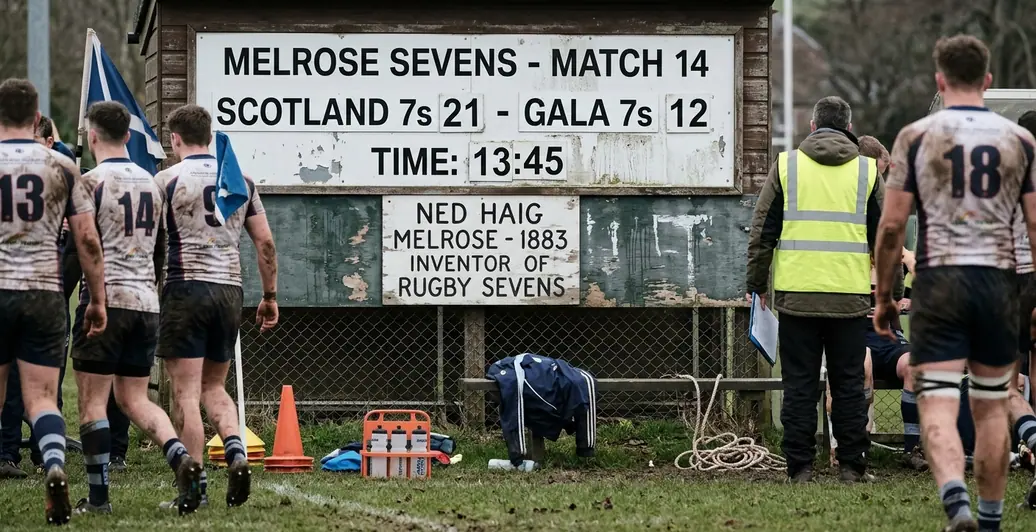
That three-official arrangement made sense in a compressed contest. With fewer players and more open ground, decisions came quickly. The administrators needed coverage as much as the players needed lungs.
- One full back guarded the rear space.
- Two quarter-backs linked defence, handling, and attack.
- Four forwards preserved the contesting character of rugby.
- Two umpires and one referee managed the early law structure.
The first champions did not win a miniature exhibition. They won a newly engineered tournament under rules specific to its time.
The Spread of the Sevens: From the Borders to the World
Regional adoption before international reputation
The common question is simple: how did a Melrose solution become a wider rugby form? The answer starts close to home. Galashiels F.C. hosted its own tournament in 1884, showing that the format could travel across the Borders almost immediately.
That early adoption was not accidental. Nearby clubs faced similar pressures: limited afternoons, strong local rivalries, and a public willing to watch a concentrated rugby event. Sevens gave them a repeatable structure.
The winner's circle widened as the tournament matured. Tynedale became the first non-Border side to win in 1886, a significant marker because it showed that the Melrose event could attract and reward clubs beyond the immediate regional frame. Watsonians later became the first Edinburgh club to win in 1905, bringing city rugby into the honours story.
Circuits, calendars, and wider recognition
As more clubs adopted the format, regional tournament life began to harden into recognizable circuits. The Spring Sevens and Autumn Sevens gave shape to what had started as individual club enterprise. A calendar gave the game memory; repeated meetings gave it status.
The Middlesex Sevens, founded on April 24, 1926, shows how the format continued to move beyond its Borders origin. Its later place in the story belongs to a broader account of rugby sevens expansion, but the line from Melrose remains visible.
For readers tracing the official global account, World Rugby's overview of the historical development of rugby sevens provides a useful companion to the Melrose-centred record.
Important: Expansion did not happen at the same pace everywhere. Borders clubs, city clubs, and clubs outside Scotland adopted the format under different local conditions.
Enduring Trophies and Tournament Evolution
Silverware as archive, not ornament
Trophies do a particular kind of historical work. They turn a one-day event into a chain of custody. Names, dates, and inscriptions make achievement portable across generations.
The Melrose tournament's silverware began with the original silver cup donated by the Ladies of Melrose. That gift matters because it places the early tournament within a civic network, not just a club ledger. The event drew its meaning from the town that hosted it.
In 1895, the current Ladies Cup was introduced. Over time, that line evolved into the premier Ladies Centenary Cup, giving the tournament a central object around which memory could gather. Players chase the cup, but historians read it as evidence of continuity.
The runners-up and the Sanderson name
The Sanderson Silver Salver, awarded to the tournament runners-up, adds a careful balance to the honours structure. It recognizes the side that reaches the final stage without flattening the distinction between champion and finalist.
Its name also keeps D. Sanderson within the tournament's living vocabulary. That is good heritage practice. A name from the first competition remains audible in the modern ceremony, linking tactical brilliance in 1883 with the formal presentation culture that followed.
- The original silver cup connected the event to the Ladies of Melrose.
- The Ladies Cup, introduced in 1895, became central to the tournament's premier honour.
- The Sanderson Silver Salver preserves the status of the runner-up and the memory of an early standout player.
Commercial Growth and Preserving the Legacy
From local fundraiser to supported sporting event
The modern tournament has had to live in two worlds. It remains rooted in the Melrose Rugby Club and The Greenyards, yet it operates in an environment where staging, travel, media expectations, and crowd experience require serious organization.
Commercial support did not create the tournament's meaning. It helped the event keep functioning at a scale its founders could not have planned for. Title sponsorships associated with names such as Tilney Investment Management, Mathon Finance, and CALA Homes are best read as markers of modern viability rather than as replacements for historical identity.
This distinction matters. A heritage event can accept contemporary economics without surrendering its origin story, provided the archive stays visible and the founding narrative is handled with discipline.
What must be protected
The challenge for Melrose is not simply to celebrate age. Age alone can become decorative. The stronger task is interpretation: explaining why a seven-a-side solution in 1883 still shapes how people understand speed, space, and risk in rugby.
The Kings of the Sevens circuit and later global tournaments widened the format's audience, but the historical soul remains anchored to Melrose Rugby Club. The documentary trail is strongest around Melrose and the Borders, so global adoption is treated here as a connected legacy rather than a complete country-by-country map.
For archive strategy, the practical priorities are clear:
- Keep the origin precise: Ned Haig's proposal, April 28, 1883, and the committee problem should remain central.
- Interpret the rules: early formations, touch-down rules, and officiating structures help readers see the original game on its own terms.
- Name the people: Haig, Sanderson, the Riddells, and the first finalists prevent the story from becoming anonymous folklore.
- Connect silverware to civic memory: cups and salvers should be presented as evidence of continuity, not merely as prizes.
Bottom Line: Rugby sevens rose because it was useful before it was famous. Melrose gave the game its working model, and The Greenyards still gives it its historical centre of gravity.