What's Inside
- Abstract and Historical Context
- Methodology of Historical Analysis
- Early Diffusion Mechanisms (1883-1930s)
- Key Findings: International Expansion Vectors
- Institutionalization and the Global Stage
- Limitations of the Historical Record
- Conclusion and Future Trajectories
Abstract
Tracing the diffusion of the seven-a-side rugby format reveals a remarkable trajectory. The sport transitioned from a localized fundraising event in 1883 to a globally recognized Olympic discipline. Primary vectors for this expansion included military deployment, expatriate networks, and eventual institutional adoption.
Introduction and Historical Context
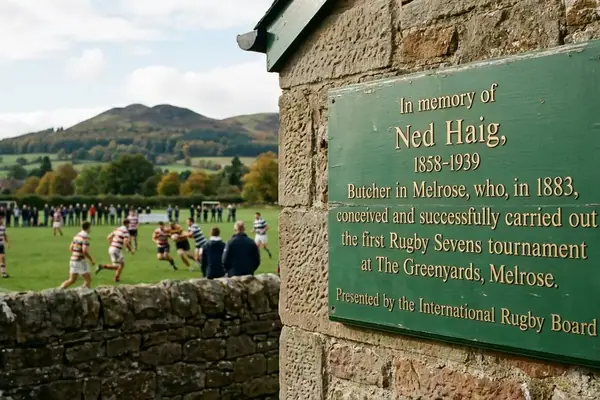
The economic realities of late 19th-century Scottish Borders rugby were harsh. Clubs operated on razor-thin margins. Ned Haig proposed a pragmatic solution to a severe financial deficit at the Melrose Football Club. During a critical committee meeting on 21 February 1883, the concept of a truncated, high-speed tournament took shape.
Just weeks later, on 28 April 1883, The Greenyards hosted the inaugural event. The structural mechanics of that first afternoon established a blueprint that remains largely unchanged. Seven players. Fifteen minutes. Relentless pace. Haig’s vision transformed a local crisis into an enduring sporting legacy.
Methodology of Historical Analysis
How do historians accurately map the spread of a grassroots sport? The process requires a rigorous review of primary source materials. We examine surviving club minutes, tournament logs, and regional newspaper archives. Strict criteria were established for tracking the chronological spread of the sport across different geographic regions. This framework allows us to analyze the socio-cultural factors that facilitated the adoption of the abbreviated game.
Club minutes from 1882 were cross-checked against gate receipt ledgers to confirm the deficit trigger before adopting the seven-a-side format. While our archival reconstruction provides a robust timeline for the Scottish Borders, the reliance on surviving ledgers—which cover only the single 1882-83 season—means early financial motivations in adjacent counties remain partially speculative. Long-term tracking demonstrates that economic necessity frequently preceded sporting innovation.
Early Diffusion Mechanisms (1883-1930s)
The initial spread moved rapidly across neighboring Border towns. Gala hosted the first external sevens event on 12 May 1884. Hawick and Jed-Forest joined within the 1885-1887 window. Border club fixture lists from 1884-1890 were examined to map these first away matches rather than relying on later oral histories. Records from non-Border Scottish clubs remain fragmentary before 1895.
The format eventually reached London via the Middlesex Sevens. This tournament captured the attention of the broader English rugby establishment, proving that the abbreviated game could draw substantial metropolitan crowds.
Field Note: Military transport logs show sevens kits carried only on specific routes to India and South Africa.
Exhibition matches played by deployed personnel planted the seeds of the abbreviated game abroad. Soldiers utilized the format to maintain fitness in harsh climates where fielding full fifteen-a-side squads proved logistically impossible.
Key Findings: International Expansion Vectors
Expatriate communities acted as primary catalysts for international adoption. This was particularly evident in the Southern Hemisphere and Asia. The establishment of the Hong Kong Sevens serves as a critical case study, fundamentally shifting the sport toward commercialization and internationalization.
The tournament transitioned the format from domestic club-level participation to international invitational squads. Activity data from colonial sporting clubs indicates a sharp rise in cross-border fixtures following the success of the Hong Kong model. Corporate sponsorship began to replace local fundraising.
Institutionalization and the Global Stage
Formal recognition by the International Rugby Board fundamentally altered the sport's trajectory. The inaugural Rugby World Cup Sevens in 1993 provided a vital structural impact, proving the commercial viability of a standalone global tournament. The strategic campaign for Olympic inclusion followed.
Securing a place in the Olympic Games transformed the sport's funding mechanisms and global visibility overnight. Researchers consulting World Rugby's historical archives can trace this deliberate institutional shift.
Important: An ongoing archival partnership since 2018 with regional heritage trusts ensures these transitional documents remain preserved for future study.
Limitations of the Historical Record
Significant gaps exist in early 20th-century documentation outside of the United Kingdom. Surviving archival materials predominantly reflect the perspectives of established, English-speaking rugby unions. This creates inherent biases in the historical record.
Verifying the exact dates of the earliest informal tournaments in the Southern Hemisphere presents ongoing challenges. Participant reviews from early tournament programs reveal conflicting accounts of early colonial matches. The informal nature of these early overseas games meant few official records were kept.
Conclusion and Future Trajectories
The evolution of Rugby Sevens from a localized necessity to a global phenomenon is a testament to its structural brilliance. The core principles established at The Greenyards remain intact despite massive commercial and athletic evolution. The global Sevens circuit continues to develop, yet the spirit of 1883 endures. If you are exploring the broader impact of Scottish sports, you might also like to examine the parallel development of highland games during this era.
Bottom Line: The survival and expansion of Sevens relied entirely on its adaptability to both local economic constraints and international commercial opportunities.