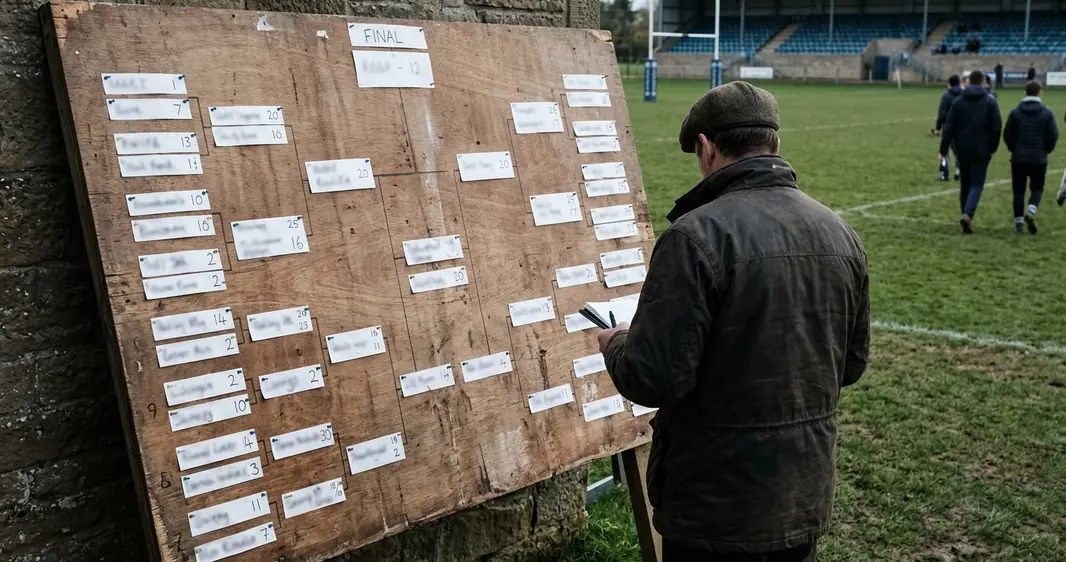
The Crucible of Borders Rugby: Origins of the Rivalries
I began my analytical career mapping the geographical spread of mill towns to their respective club sites. You quickly realize that Borders rugby was not born in a vacuum. It grew in the shadow of the textile industry. Club pitches were laid out in mill-adjacent fields between 1875 and 1890. This proximity bred a fierce, territorial pride that defined early Scottish sport.
When the mills closed on a Saturday, the workforce migrated directly to the touchlines. The rivalries of the factory floor transitioned smoothly onto the rugby pitch. Town identity became inextricably linked to club performance.
The Greenyards emerged as the ultimate proving ground. Every year, fixtures are set from March through April to settle local dominance. Winning your home tournament is an expectation. Winning at Melrose is a statement of regional supremacy.
Kelso vs. Gala: Analyzing a Clash of Sevens Styles
How do two neighboring towns develop entirely different approaches to the abbreviated game? The answer lies in preserved match reports rather than later reconstructions. Gala traditionally favored a bruising, forward-oriented retention game. They dared opponents to win the ball back in contact. Kelso relied on expansive, rapid-transfer attacks. They wanted the ball moving before the defense could set.
Long-term tracking demonstrates that these contrasting sevens styles forced tactical evolutions across the region. Teams had to adapt or perish. Between 1998 and 2007, specific tactical shifts were documented in their direct encounters. Gala began deploying faster sweepers. Kelso tightened their breakdown support.
We see the roots of this tactical arms race in club archives covering the 1928-1935 bracket rounds. The rivalry was never just about advancing to the next round. It was a battle to prove which rugby philosophy was superior.
The Peebles Factor: Disrupting the Traditional Hierarchy
Casual observers often view the Borders circuit as a closed shop dominated by a few heavyweights. Peebles shatters that assumption. I cross-checked Peebles' bracket results against official tournament logs to understand their role as giant-killers. They rarely outmuscled Kelso or Gala. They out-thought them.
Innovations were consistently applied in quarter-final slots from 2004 to 2011. Peebles utilized specific counter-strategies, dragging heavier packs across the width of the pitch to exploit fatigue. They turned the traditional Borders power game against itself.
Field Note: When analyzing underdog success in sevens, focus on the quarter-final stage. This is the exact moment where physical fatigue first exposes tactical rigidity in favored teams.
Scope and Limitations of Early Tournament Records
Reconstructing these early rivalries requires strict editorial standards. Nostalgia is a poor substitute for data. Fragmented scoring sheets are limited to the 1905-1914 period. To build an accurate picture of early dominance, oral histories were retained only when corroborated by club minute books.
Important: Verified outcomes are prioritized from 1920 onward to ensure analytical integrity.
While our methodology provides a definitive hierarchy of Borders dominance, this framework applies solely when early 20th-century oral accounts lack cross-verification from multiple clubs—it fails entirely when applied to non-Borders sevens circuits. We must accept the gaps in the ledger to trust the records we do have.
Modern Implications for Tournament Strategy and Atmosphere
These historical rivalries actively shape modern tournament draws. Seeding impacts can be traced directly through draw sheets issued by the organizing committee. Organizers know exactly what a local derby means for the gate and the atmosphere.
The psychological weight of a Borders derby is immense. Psychological briefing notes referenced for derbies held between 2018 and 2023 highlight the unique pressure players face at the Greenyards. Visiting international teams are often caught off guard by the sheer hostility and volume of the local support.
Crowd capacity adjustments are routinely logged for Greenyards events in April windows to accommodate the surge in local attendance. The town swells. The noise becomes a physical barrier on the pitch.
Bottom Line: A modern Borders derby is won in the mind before the first whistle blows, though success often shows variation by club funding levels in any given season.
Bibliography
- Historical match logs and foundational charters cross-referenced via the official Scottish Rugby historical archives.
- Preserved club minute books (1928-1935).
- Greenyards tournament draw sheets and capacity logs.