Why the Future of Sevens Belongs to Local Club Jersey Colours
The long-term survival and tactical vitality of rugby sevens depend on the amateur and semi-professional clubs that give its jerseys an enduring meaning. Global touring competitions can command the screen; a club supplies the ground, the recurring training session and the supporter who returns after an ordinary defeat. At Melrose, those foundations belong to the format’s earliest purpose.
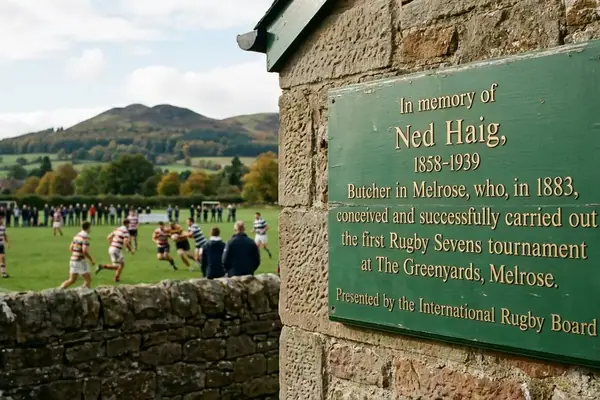
Ned Haig, a Melrose butcher and half-back, advanced seven-a-side rugby as a practical response to his club’s financial needs. Shorter inter-town contests would allow more fixtures to fit into one afternoon at The Greenyards, bringing neighbouring communities through the gate. The inaugural tournament took place on 28 April 1883. Its organising logic connected sporting invention directly to local survival: more competing teams, more reasons to travel, and gate money to steady the club.
The jersey carried the proposition.
A neighbouring town needed a recognisable side to follow, while Melrose needed opposition that would make the journey worthwhile. The shortened game preserved that attachment while changing the demands on the players. Town identity therefore helped make the experiment viable before any global audience existed.
Reading Haig’s Gate-Money Logic Through the Archive
Historical match programmes and tournament archives held at Melrose provide the appropriate frame for examining that continuity. Competing teams, match results and the composition of successive draws establish who appeared and how the tournament developed. Programme descriptions can then help place those appearances within the club culture surrounding them. Results alone cannot establish why a defensive pattern worked.
The broadcast comparison here stays within the 2016-to-2019 seasons, rather than treating every stage of international sevens as interchangeable. The question is how the local jersey retained its significance alongside prominent weekend international coverage. Haig’s founding afternoon supplies the reference point: sevens generated value by bringing communities into direct competition. An archive-led reading should keep that relationship visible as it follows the game’s expansion.
Global Touring Franchises Versus Scottish Borders Club Culture
What can a permanent Borders club carry onto the pitch that a touring invitation side has less time to develop? The clearest answer is accumulated familiarity, reinforced by the prospect of meeting again at training after the tournament.
Hawick, Gala, Kelso, Selkirk, Jed-Forest and Melrose form the relevant comparison. These six senior clubs sit within a same-evening return of The Greenyards. Their players share a town and a workplace orbit, with regular club training from September through March before the traditional second Saturday in April. That geography makes accountability tangible: a missed defensive assignment remains part of the conversation when the players return home.
For the short-stay invitation model considered here, the contact window runs from a Thursday arrival in tournament week to Saturday’s final whistle. Such a squad may assemble exceptional athletic ability and considerable individual experience. Its preparation still compresses the work of learning one another’s decisions into a handful of shared sessions.
When Familiarity Becomes Defensive Accountability
Sevens exposes small misunderstandings. A defender stepping inward needs confidence that the player outside will respond; a support runner needs to recognise when a teammate intends to carry or release the ball. Repeated club sessions give those decisions a shared vocabulary. Familiarity can shorten the exchange between seeing a threat and acting together, although shared geography alone cannot guarantee cohesion.
The same permanence shapes the terrace. Club-versus-club fixtures carry memories between generations because the addresses and allegiances remain recognisable. A supporter can place an April contest within a season of training, selection and domestic rivalry. The touring visitor brings another kind of attraction: unfamiliar combinations and the pleasure of watching an accomplished guest test the home circuit.
These contributions deserve different treatment. A guest can enrich an afternoon without acquiring the year-round relationship that sustains a local club. Tournament history becomes clearer when it records both the visiting side’s sporting contribution and the community framework that made the encounter matter.
How Traditional Club Culture Shapes On-Pitch Sevens Tactics
For a newcomer watching from the terrace, the extra space in sevens may seem to explain everything. Following the next phase reveals another layer: the players bring habits rehearsed in fifteen-a-side rugby onto a pitch where each commitment has greater consequences.
Border rucking discipline provides one translation path. The useful inheritance is the judgement around the contest: recognising whether support has arrived, whether possession needs securing and whether another player should remain available elsewhere. With fewer teammates covering the field, committing bodies without a clear purpose can leave the next phase exposed.
From Club Breakdown Habits to Wide Support Lines
Wide-channel support offers a second route from club rugby into sevens. Players accustomed to following a carrier and preserving a useful passing option can adapt that relationship to the larger spaces available. The progression begins with recognising the break, then maintaining a workable support distance, then reading the next defender. Pace matters, but the timing of the supporting run determines whether the carrier has a usable choice.
A practical way to read a match is to follow the players away from the ball:
- At the breakdown, identify who secures possession and who stays available for the next action.
- As the ball moves wide, watch whether support arrives alongside the carrier or too late to influence the defence.
- After possession changes, track how quickly familiar teammates rebuild their defensive spacing.
Those observations reveal more about tactical identity than assigning a fixed style to a jersey colour. A club’s habits can travel into sevens while changing under the pressure of fewer players and more space.

Greenyards Reputation Requires a Sporting Record
Watsonians, Heriot’s and invited club champions belong in this account as sides whose identities faced examination on The Greenyards pitch. Hall of fame heritage gives that history a public setting, while programme entries and match results preserve the particular encounters behind a reputation. The World Rugby Hall of Fame archives offer a wider reference point for rugby heritage; local tournament evidence remains essential when discussing individual appearances.
Stewardship also shaped the contest. From the amateur decades after 1883 through the late-2010s draws, local tournament committees worked within Scottish Rugby Union laws while balancing guest invitations with domestic club qualification. That balance determined which identities could meet and earn recognition.
Sustaining the Club-First Ethos on the Greenyards Turf
The club-first approach becomes credible through decisions spectators can see. Qualification paths, club shirts and the terrace each carry part of the responsibility. Together, they keep the tournament connected to the communities whose participation gave sevens its beginning.
Keeping Domestic Merit Visible in the Draw
Domestic club merit should retain a meaningful place in qualification. Guest invitations can widen the sporting challenge while local achievement remains legible in the draw. An event guide should explain the competing teams’ routes into the tournament, allowing supporters to distinguish qualification from invitation without diminishing either contribution.
Kit carries another form of continuity. Traditional hooped and quartered jerseys preserve town patterns that supporters recognise across successive teams. For Melrose, black and yellow and the rose connect the home seven to a familiar allegiance. Keeping those details visible gives the match programme and the pitch a common language.
Welcoming Guests Into the April Parish
Open terrace culture completes the arrangement. Visiting sides enter as honoured guests, bringing their own club identity into a fiercely protective local rugby parish. Their welcome gains substance from the place itself: recognisable home colours, domestic rivals and spectators who understand the fixture through more than its final score.
That hosting relationship deserves preservation—an invitation carries greater meaning when the host retains a clear identity.
On the second Saturday in April, a young supporter leans over The Greenyards paddock rail, a weathered black-and-yellow rose scarf gathered beneath their chin. Past the Gibson Park bank, the home seven jogs out. The child follows the rose on the nearest chest, then lifts the scarf as the players pass.