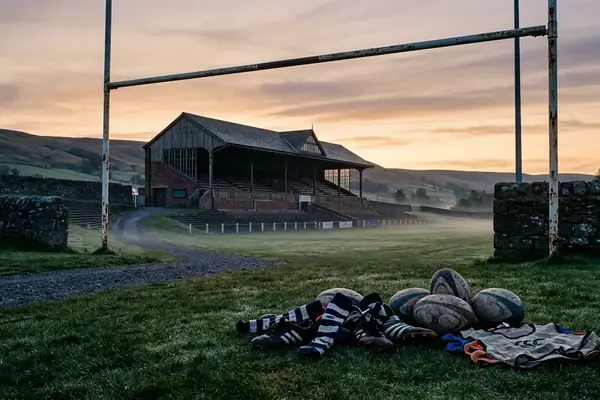
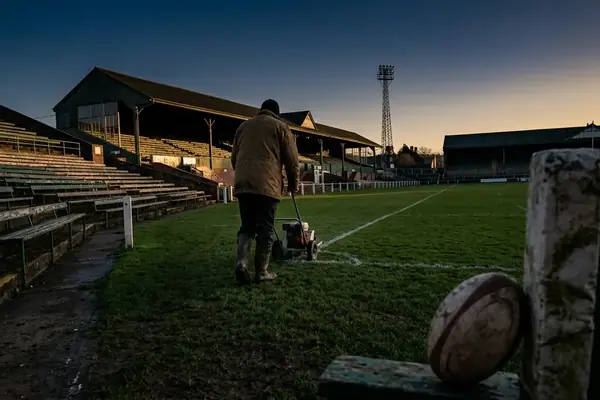
Why Melrose Begins Before The Greenyards
Visitors arriving on tournament Saturday face an obvious pull: follow the crowd, reach the grandstand gates, and settle in before the opening ties. That efficient route also passes over much of the story that gives the Melrose Sevens its prestige.
Route stewards recognised the problem after watching supporters unload at the town approaches and treat the ground as their only destination. On recent tournament Saturdays, the heaviest footfall has run directly from the transport drop-off towards the gates. The High Street frontages connected with the funding of the original cup sat outside that flow.
A pitch-side briefing was considered and dropped because it separated seven-a-side play from the 19th-century trades that sustained its beginnings. The walk therefore starts while Melrose is still gathering itself for the day. Coaches have stopped, competing teams are preparing, and conversations spill into the streets.
The interval when the town comes alive
The street atmosphere builds across the hour or so — somewhere between 55 and 85 minutes — separating the arrival of the coaches at the town approaches from the opening ties. That window gives visitors enough time to read plaques, inspect surviving shopfront details, and understand why a butcher's premises belongs in the tournament history.
The route can be understood as a butcher-lintel-to-turnstile sequence. Its first part explains how High Street trades helped pay for the cup. Its closing part carries that history towards the pitch where seven-a-side rugby emerged.
The grandstand presents the spectacle. The streets explain how Melrose created it.
For a first visit, the practical choice is simple: resist the fastest stream towards the gates and begin at the Mercat Cross. Experienced spectators can use the same route to place familiar match-day landmarks within a much older civic pattern.
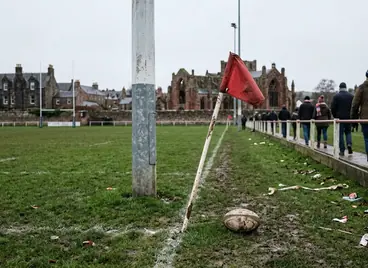
Haig, Sanderson and the Trades Behind the First Cup
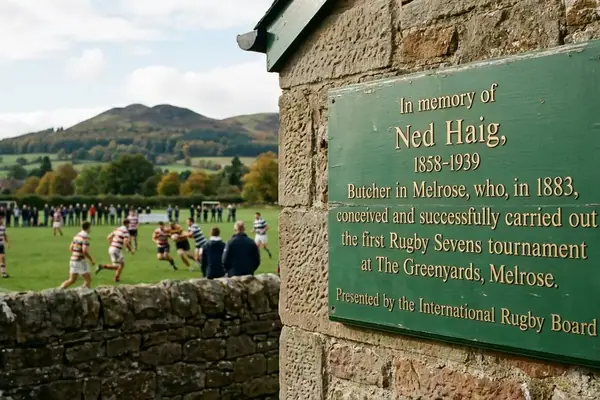
The walk's heritage lineup begins with Ned Haig and David Sanderson. Both names connect the formation of the local club in 1877 with the 1883 sports day at The Greenyards, where seven-a-side play was introduced.
Haig's occupation matters to the route. As a local butcher, he belonged to the commercial life represented by the High Street frontages rather than to a separate sporting world. Sanderson stands alongside him in the founding account, while the butchers and other tradesmen who underwrote the first cup broaden the story beyond two individuals.
Reading plaques against surviving stone
Curators ordered the principal names by pairing each founder with a street frontage still carrying a local historical-society plaque. Haig and Sanderson lead. The supporting trades follow in the sequence of surviving shop lintels, allowing the financial foundations of the competition to unfold as a physical journey.
Archival match lists covering the 1883–1892 seasons reinforce this sequence. They connect the early event with the frontages whose occupants paid for the cup, giving the visitor a route grounded in records rather than a loose collection of commemorative stops.
The masonry requires careful reading. Plaques align cleanly with named founders only where original street numbering survives. Several buildings behind the inscriptions were reconstructed during later High Street refits, so a visible plaque may mark the correct historical location without preserving the complete 1883 structure.
What deserves attention at each frontage
- The name: identify whether the plaque refers to a founder or to one of the trades supporting the cup.
- The lintel: examine how the surviving frontage fits within the wider run of shops.
- The numbering: check whether the historical address still corresponds with the present street sequence.
- The fabric: distinguish a commemorated site from stonework that demonstrably survives from the early tournament period.
Visitors extending their archival work after the walk can compare listed-site context through Scotland's historic environment records. The plaques remain the route's immediate evidence; the records help place later alterations within a broader built-heritage context.
From the Mercat Cross Through the Early Team Rooms
Where should the historical walk begin? The Mercat Cross provides the clearest answer because it places the visitor within the town centre before the pre-match crowd reaches its greatest concentration.
The opening leg takes on the order of 20 to 35 minutes. It passes from the cross through the historic inns and public houses used as gathering rooms on tournament mornings from 1883 into the early 1890s. These rooms performed many of the functions later associated with formal changing and preparation areas: sides assembled, discussed the coming matches, and returned after play.
Following the first-half route
- Begin at the Mercat Cross and establish the direction of the principal High Street frontages.
- Move through the inn yards in the order associated with the gathering places used by early sides.
- Pause where plaques and surviving lintels connect individual trades with the first cup.
- When the square fills, peel into the quieter wynds rather than pushing against the direct grandstand flow.
- Rejoin the closing approach only after the town-centre sequence has been read in full.
Marshals fixed this order to preserve the relationship between the square, the inn yards, and the quieter passages beyond them. It also gives the walk a useful rhythm. Dense architectural detail comes first; easier movement follows as the main body of spectators continues towards The Greenyards.
Footwork for a busy tournament morning
The busiest route is also the least informative one. Supporters moving directly from the transport approaches to the gates tend to miss the shopfront sequence, while visitors who linger in the square too long can become caught in the same flow.
A measured pace works better. Read the plaques before the crowd thickens, use the inn yards in sequence, and move into the wynds once the square fills. This keeps the historical order intact without asking the visitor to stop in the heaviest stream of foot traffic.
The Monument, Old Turnstiles and Eildon Hills
The character of the walk changes after the last town street. Shopfront evidence gives way to the physical approach to The Greenyards, and the remaining distance takes approximately 12 to 18 minutes.
Ground staff designed this closing line around two fixed references: the Ned Haig monument and the historic turnstile area. Together they deliver the walker towards the same Eildon Hills backdrop recorded in match sketches from the 1880s.
Finding the historic pitch axis
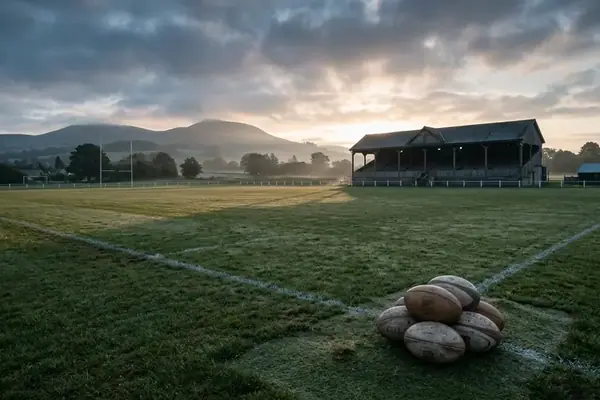
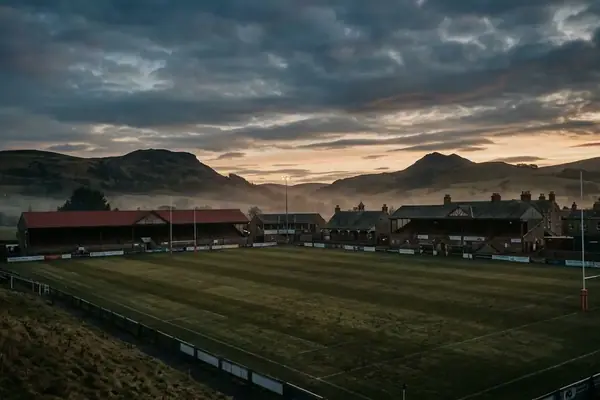
The crucial view appears from the old turnstile line. From there, the monument, turf, and triple-peak frame of the Eildon Hills occupy the historical axis. That composition collapses when the ground is entered from the coach bays, which explains why a direct arrival can feel geographically complete while missing the visual logic preserved in the sketches.
Stop at the turnstile line before moving farther into the ground. Face across the turf, find the monument in relation to the pitch, and then raise the sightline towards the hills. That short exercise turns the landscape into evidence: the modern event occupies a setting recognisable from the earliest visual record of Melrose match play.
When reflection meets tournament noise
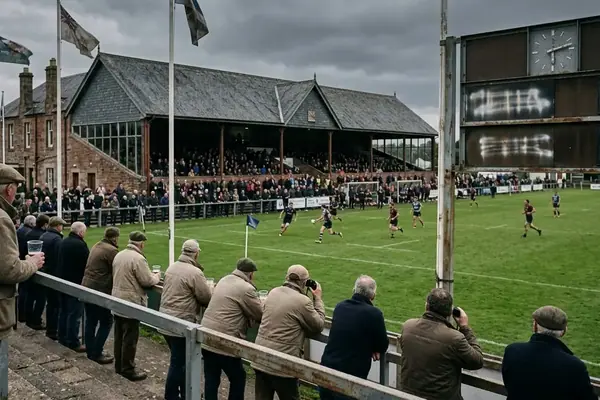
The approach also manages a deliberate change in atmosphere. Along the High Street, attention narrows to inscriptions and altered fabric. Near the monument, the view opens. Crowd noise grows, announcements carry across the ground, and the celebratory energy of the modern tournament takes over.
This transition gives the walk its narrative force. The visitor reaches The Greenyards with Haig's trade, the cup-funding frontages, the early team rooms, and the surrounding landscape held within one continuous route—then enters the living competition those elements helped create.
Arriving at the Pitch Before the First Whistle
The walk finishes at the heritage tent some 15 to 25 minutes before the first whistle. This timing leaves a practical pre-kick window without detaching the historical route from the matches it was designed to illuminate.
By this point, The Greenyards carries more than the immediate expectations of match results and competing teams. Its significance rests on a connected sequence: local trades financed the cup, inns accommodated the early sides, seven-a-side play took shape at the 1883 sports day, and the pitch remained framed by the Eildon Hills.
Turn the route into a match-day reference
The official program now serves as a working event guide. Use it alongside the view from the seat rather than putting it away immediately. The names and ground layout should relate back to the founder plaques, old turnstile line, and boundary marks identified during the approach.
The most useful final action takes only a few minutes: buy the official program at the heritage tent, locate the assigned seat, and identify the historic boundary lines from that position before the first whistle blows.