The 1883 Waverley Route and Its Modern Revival
The foundation of the Melrose Rugby Sevens is inextricably linked to the railway infrastructure of the late nineteenth century. The 1883 committee sited the sevens at The Greenyards because the Waverley Route already dropped sides and spectators within a short walk of Melrose. This logistical advantage allowed the tournament to draw competing teams and crowds from across the region, establishing the event as a premier fixture in the sporting calendar. The tournament's hall of fame is filled with legends who first arrived via these historic transport corridors. Tournament traffic relied heavily on the Waverley Route from that inaugural meeting until passenger services ended in January 1969.
The withdrawal of these services forced a significant shift in how supporters accessed the town. Organisers and fans lived with road-only access for decades, fundamentally altering the match-day experience and placing immense pressure on local infrastructure. The revival of the Borders Railway changed the dynamic entirely. The new line opened to Tweedbank in September 2015, serving the 2016–2019 tournament cycles as the southern rail head. Terminating the revived Borders line at Tweedbank was a deliberate catchment decision designed to restore the original Edinburgh to Borders rail head so tournament traffic could again flow smoothly.
This modern terminus sits about 2 to 2.5 miles from The Greenyards. Traveling by rail connects contemporary supporters directly to the tournament's foundational roots, recreating the arrival experience that helped build the event's legendary status. Tracking the revived Borders Railway across the 2016–2019 tournament cycles establishes a clear baseline for modern event logistics. The revived line shows that rail access remains as vital to the tournament today as it was in 1883.
Escaping the Gridlock of Medieval Streets
Understanding the physical constraints of Melrose is essential for planning a successful match-day arrival. Stewards and the roads authority measured what Melrose’s medieval frontages can physically hold and then set private cars aside as the lead arrival mode. The historic core funnels vehicles onto a handful of single-carriageway streets with limited marked parking at the ground. High Street, the lanes around St Dunstan’s, and the few marked bays near The Greenyards fill once residents and coaches are counted—leaving no room for speculative parking.
Inward movement concentrates heavily in a 90 to 150-minute window before the opening ties. This timeframe represents the highest risk for severe gridlock. Event guides lead with rail-plus-walk and bus-plus-short-walk strategies to keep the inbound pulse off those stressed streets. Relying on public transport and active travel reduces arrival pressure and prevents the town's infrastructure from being overwhelmed by thousands of simultaneous vehicle arrivals.
The geographical reality of the town dictates that high-volume events require high-efficiency transport solutions. By choosing to leave the car behind, supporters actively contribute to the smooth operation of the tournament and protect the historic character of the host town. The focus on sustainable, mass-transit options reflects a necessary adaptation to the enduring popularity of the Melrose Sevens.
Mapping the Borders Transit Arteries
The regional transport network relies on two primary arteries to move supporters into the town. The system is built around the Borders Railway ending at Tweedbank and the regional buses that interchange at Galashiels for Melrose. For travelers originating in the Central Belt, the Borders Railway route provides the most efficient connection. Edinburgh Waverley to Tweedbank end-to-end running time sits in the 55 to 65-minute range on standard diagrams. These services often operate at 30-minute headways, providing a predictable and frequent schedule for inbound fans.
The Edinburgh to Tweedbank rail sequence does not serve travellers already in Hawick, Kelso, or Selkirk after the last useful Tweedbank arrival; those starts need the Galashiels bus leg as the primary move. Galashiels to Melrose connecting buses typically occupy a 10 to 20-minute in-vehicle window. Weekend headways for these bus routes often run 30 to 60 minutes unless a specific event overlay is advertised. Frequency is taken from the standard weekend diagram, with any extra event overlay treated as contingent.
Rail serves as the primary tool for Central Belt arrivals, while the bus network provides the essential link for travelers already inside the Borders towns that the new rail alignment does not serve. Evaluating the frequency and capacity of these services allows supporters to select the most appropriate route based on their starting location. While fans focus on match results, the underlying logistics of getting to the ground dictate the rhythm of the entire day.
The Final Two Miles Along the River Tweed
The journey from the rail terminus to the stadium involves a dedicated active travel corridor. The last mile was committed to the River Tweed corridor, with markers at the station forecourt, the river crossing, and the ground approach. This wayfinding system directs alighting supporters along one signed path to the venue.
Tweedbank Station to The Greenyards is roughly a 2 to 2.5-mile surface route. The walk typically requires 35 to 50 minutes on foot. The path is largely level riverside and shared-use track, offering a scenic and straightforward approach to the town. The main physical effort involves a climb in the final 400 to 600 metres into the ground.
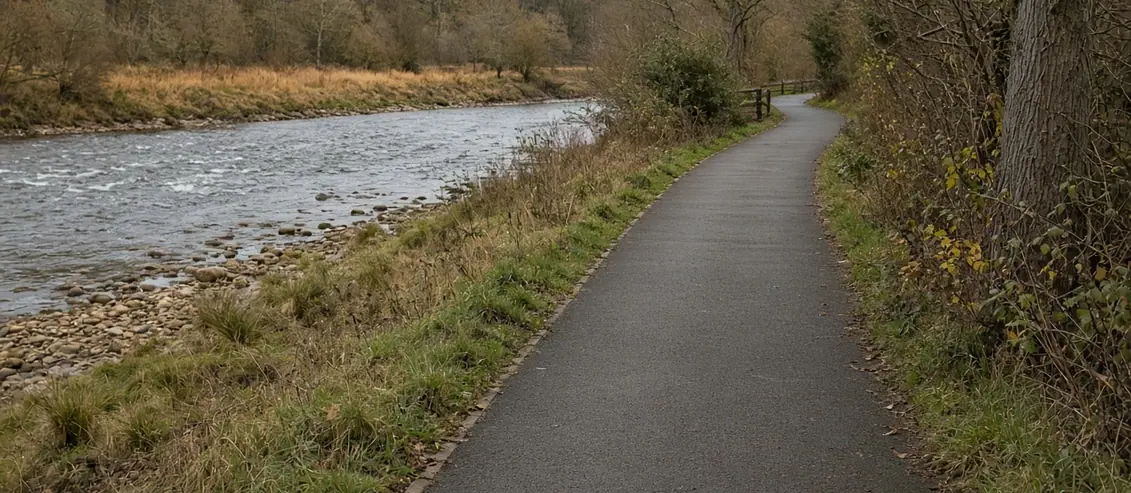
Secure racks at the ground end were included so cyclists can treat Tweedbank as a rail-and-ride head and walk the same final metres as pedestrians. This infrastructure supports an easy transition from rail to active travel. The riverside route provides a safe, vehicle-free environment for the final leg of the journey, allowing fans to build anticipation as they approach the historic venue. The integration of walking and cycling paths into the broader transport strategy highlights the commitment to reducing local congestion and promoting sustainable event access.
Mastering the Galashiels Bus Interchange
Navigating the regional bus network requires specific tactical knowledge during high-demand periods. The sequence is written from the Galashiels interchange so passengers board at a stand that still feeds Melrose when High Street is closed. Interchange-to-town-centre running time is commonly 10 to 20 minutes. High-demand boarding windows run 75 to 120 minutes before the kick-off of the opening ties.
Ticketing must be handled proactively to avoid delays at the point of boarding. Purchase your fare before the stand crush because drivers cannot clear cash queues inside a compressed event headway. Alighting advice names the approach stops that remain open during ground-side closures. Identifying these strategic bus stops ensures you can access The Greenyards without navigating the road closures that affect the immediate vicinity of the stadium.
The bus network provides a vital connection for regional supporters, but its efficiency depends entirely on passengers understanding the operational constraints of match-day travel. Preparing your tickets in advance and knowing exactly where to alight turns a potentially stressful transfer into a smooth and predictable process.
Executing the Waverley to Turnstile Blueprint
To hear the opening whistle, follow this sequence from the Central Belt. The worked example starts at Edinburgh Waverley because that is the rail head with the densest morning diagram toward Tweedbank. Board a Tweedbank service 90 to 120 minutes before your intended turnstile time. Allow 55 to 65 minutes on the train for the journey south. Budget 10 to 15 minutes to clear the station platform and forecourt upon arrival. Commit 35 to 50 minutes for the signed path along the River Tweed.
Build in a 20 to 30-minute contingency before the opening tie. This buffer covers slower walkers and short platform delays, ensuring the riverside walk remains inside the plan even when a platform runs a few minutes late. Published tournament history records that, at the 1883 inaugural meeting, the Waverley Route dropped sides and spectators within a short walk of Melrose; this modern itinerary replicates that efficiency.
Car-free arrival sequence
- Confirm the Tweedbank diagram 24–48 hours out and pick a service that lands 90–120 minutes before turnstile time
- Carry a pre-purchased rail ticket and a separate local bus ticket if joining via Galashiels
- Leave Tweedbank station promptly to begin the 35–50 minute surface route along the River Tweed
In a worked example, allow 60 minutes for the train, 10 minutes to clear Tweedbank station, 45 minutes for the riverside walk, and a 25-minute contingency. That places departure from Edinburgh Waverley 140 minutes before the opening tie, with the final approach made on foot to The Greenyards.