How Melrose’s Rulebook Built a Global Game
The enduring global success of rugby sevens was not born from the speed and thrill of the shortened game itself, but from the rigid, meticulous off-pitch bureaucracy established by the Melrose community in 1883. That claim sounds contrarian at The Greenyards, where the action naturally commands attention. Yet the first achievement happened before a ball moved.
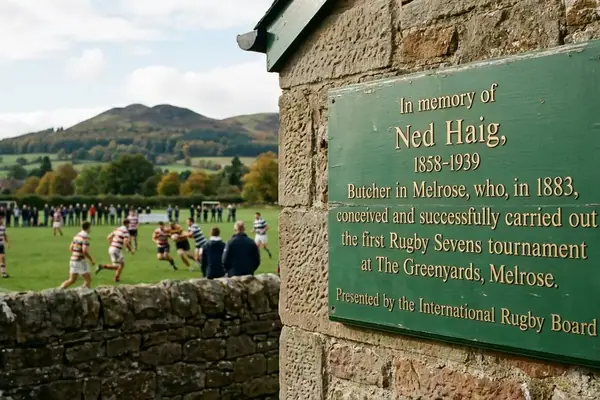
In late winter 1883, an organising committee of local butchers, bakers and tradesmen met to plan a fundraiser for Melrose Rugby Club. Ned Haig supplied the celebrated sporting concept. The committee supplied the structure that allowed his idea to survive its opening afternoon.
Rules Before Kick-Off
The organisers wrote down the entry fee, pitch limits and single-elimination draw before staging the first match. Each side paid ten shillings to enter the April card. Ties had fifteen-minute halves, followed by five-minute turnarounds across the afternoon schedule. Those decisions created a shared understanding among competing teams: everyone knew the cost, the route through the draw and the time available.
- Entry protocols established who could join the tournament and on what terms.
- Pitch limits gave the shortened format a defined playing environment.
- The knockout draw turned separate matches into one coherent championship.
- Fixed timings made a full afternoon of rugby manageable for teams, stewards and spectators.
This was practical administration rather than paperwork for its own sake. A compact tournament needed stricter timekeeping than a single fixture because every delay affected the next tie. The committee produced a framework that could be repeated the following year and understood by visiting clubs.
For broader background on 19th-century rugby administration, it helps to view Melrose within a period when written rules increasingly gave sporting customs permanence. The distinction at The Greenyards lay in how quickly the community applied that discipline to a new format.
The Melrose Principle
Fast rugby depended on careful preparation. The spectacle earned applause, while the timetable, entry rules and draw earned the tournament a future.
The Ladies’ Cup Made Victory Visible
A tournament becomes more than a sequence of match results when victory has a recognised object, place and ceremony. The Ladies’ Cup gave the first Melrose Sevens all three.
Local women completed a subscription for the silver cup in the weeks before the inaugural final. Its hallmarks place its manufacture within the Edinburgh assay cycle of 1882–1883, linking the physical trophy directly to the tournament’s founding period. Community investment therefore sat at the centre of the prize from the beginning.
Ten Minutes That Conferred Prestige
The committee required the cup and medals to be presented by a lady of the committee on the pitch within ten minutes of the final whistle. That narrow window mattered. Players remained in their kit, spectators remained gathered and the winning side received public recognition where the contest had taken place.
I return to this ceremony when interpreting the tournament history because it shows how presentation can shape sporting value. A cup stored away and delivered later would still have rewarded the winners. The immediate pitch-side ritual made their achievement part of a shared public memory.
One historical boundary deserves precision: the 1883 sequence of decisions survives through silver hallmarks and later printed programmes rather than a continuous run of committee minute books. Those sources provide a verifiable lineage for the trophy and its presentation protocol, though they cannot reproduce every discussion behind the choices.
The ritual elevated a fundraising competition into a coveted championship. It also gave supporters a reason to remain after the last whistle. The final act belonged to the community members who had funded the prize, reinforcing the connection between those who organised the day and those who won it.
Club Committees Kept the Sevens at Melrose
The opening tournament cleared the club’s debts, answering its immediate purpose. The tradesmen on the committee then made the more consequential decision: they retained the Sevens as an annual Melrose Rugby Club fixture.
From Financial Rescue to Annual Duty
Annual status changed the work. The committee had to invite sides, receive confirmations, arrange the draw, prepare The Greenyards and control an audience moving around an active rugby ground. Visiting teams were required to confirm travel by letter no later than fourteen days before the appointed Saturday. That deadline protected the schedule from late uncertainty.
Between the 1884 and 1892 editions, volunteer stewards drawn from club membership managed rope barriers around the playing area. It was modest equipment serving a serious purpose. The stewards kept sightlines usable, separated the crowd from play and allowed successive ties to begin without repeatedly clearing the pitch.
- Club members handled practical stewardship at The Greenyards.
- Visiting sides accepted written deadlines and local scheduling control.
- The committee maintained the amateur ethos while managing a growing annual occasion.
- Local authority over the fixture preserved its April setting more consistently.
The organisers refused to cede scheduling control to a wider Borders body during the formative period. Committees with a majority of local tradespeople held the April date more consistently than tournaments transferred to regional sports boards. Place, calendar and governance supported one another.
Why Local Control Mattered
Relocation or early commercial control might have separated the event from the people doing the routine work. Instead, club stewardship kept the Sevens rooted in the Scottish Borders while its reputation travelled further afield. International recognition grew around a distinctly local institution.
That model required discipline. Amateur administration still had to coordinate competing teams, spectators and match results with precision. The early committees built authority through repeated delivery rather than elaborate infrastructure—a rope barrier properly stewarded could matter more than an impressive plan poorly executed.
Keeping the Founding Rituals in the Modern Sevens
Professional circuits expanded after 1999, bringing tighter broadcast windows and the operational expectations of contemporary international sport. The modern Melrose Sevens committee responded by protecting several founding features: a majority-local organising body, community participation and the original Ladies’ Cup sequence.
Broadcast Timings Meet the Trophy Ceremony
In more recent editions, the trophy has still been presented on the main pitch, hovering around a quarter of an hour after the final whistle. The interval allows more flexibility than the first protocol, yet the essential sequence endures. The final ends, the audience remains present and the cup enters the winners’ hands on the ground where they earned it.
Community volunteers continue to operate gate and programme sales alongside contracted event staff. This arrangement pairs local knowledge with the capacity required for a modern event. A volunteer who understands the rhythms of The Greenyards contributes something different from a contractor working to an event plan; both forms of labour have a clear place.
What Heritage Requires in Practice
Heritage survives through decisions in the event guide, committee room and running order. Organisers must reserve time for the cup presentation, retain meaningful roles for local volunteers and treat the tournament history as part of the event itself. A hall of fame, trophy or archive gains force when current practice still reflects the values it records.
There is also a warning in shortened-format tournaments that removed ceremonial trophy presentations: volunteer steward numbers fell away within a few seasons. Ceremony gives voluntary labour a visible connection to the outcome. When organisers strip away that public conclusion, they can weaken the sense of shared ownership that brought people through the gate and onto the stewarding line.
Melrose has carried its founding architecture into a professionalised sporting landscape because the committee still treats tradition as an operating responsibility. As global sports franchises increasingly prioritise broadcast rights over local heritage, can the soul of a tournament truly survive if it abandons the community traditions that first built it?